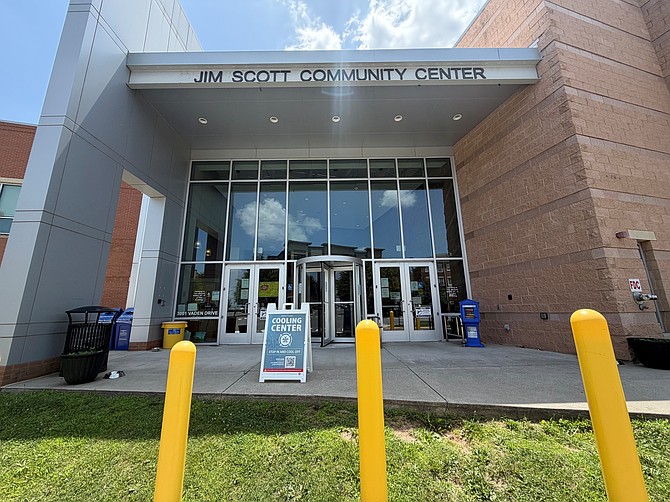
The Jim Scott Cooling Center was in use for that early July heat spell.
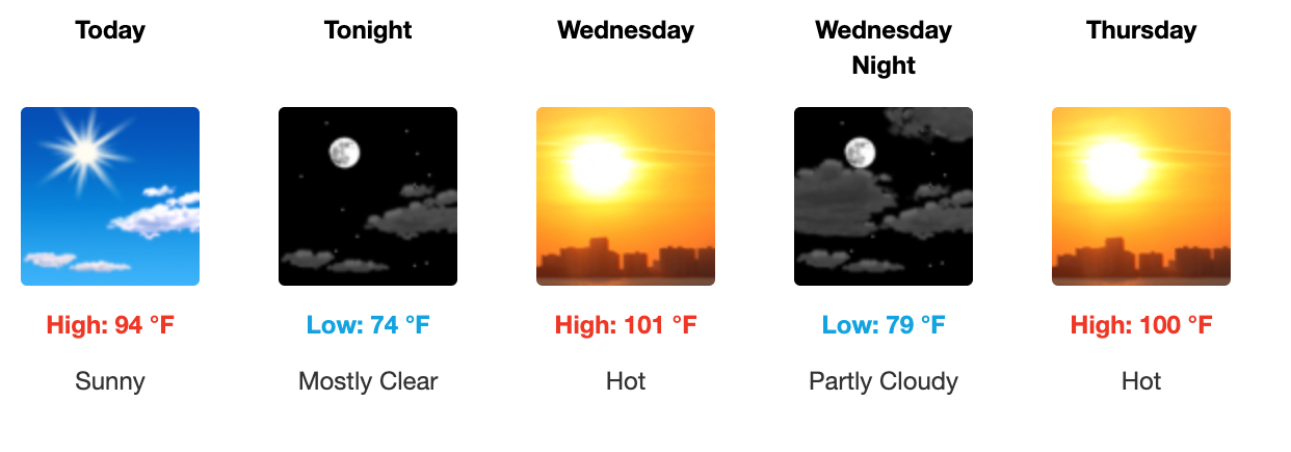 Extreme heat returning this week, July 14-16, 2026.
If the first week in July is a sign of things to come, area agencies might need to shift gears in the cooling department to avoid potential fatalities that come with temperatures in the triple digits.
On Sunday, July 5, Fairfax County activated the Fairfax County Heat Plan, designating several county facilities such as libraries, community centers, REC centers, human services offices and homeless shelters as cooling centers. Those cooling centers are equipped with supplies for community members, including water, sunscreen, insect repellant, shower wipes and free Fairfax Connector bus coupons.
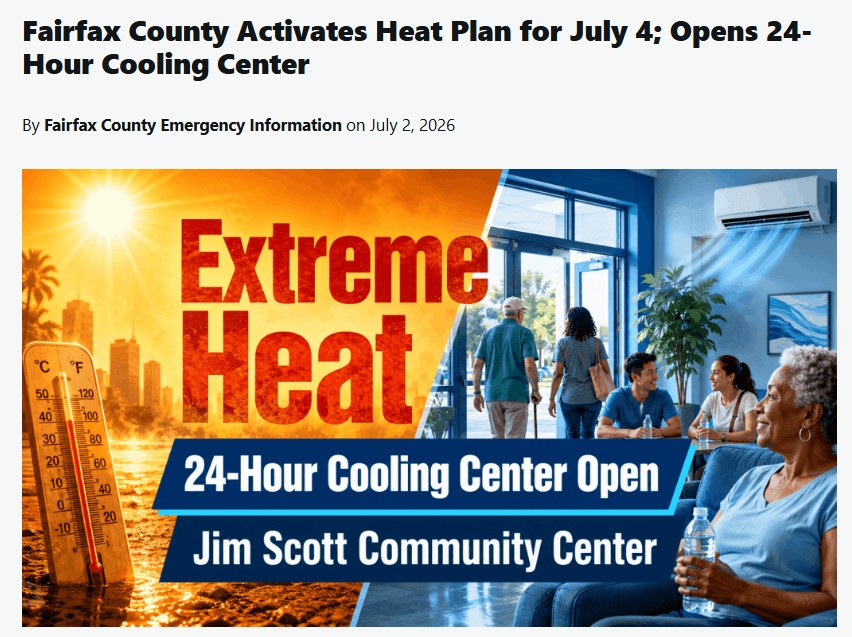
During this time, County leadership decided to open a 24/7 cooling center at the Jim Scott Community Center during the most recent extreme heat wave. It was open 24/7 starting on July 2 at 8 p.m. through July 5 at 8 a.m. and staffed continuously by county employees. The center served 85 community members over that period. Free transportation was available to anyone who needed a ride to the center or a ride from the center once it closed on Sunday morning. On Sunday, regional libraries and rec centers were open as cooling centers during their operating hours.
The National Weather Service listed the Daily Climate Normals (1991-2020) Washington Area, DC statistics on the Max Temperature Normal graph, which shows temperatures in July are all double digit numbers for the month, with 90 degrees as the high. This summer, the first week in July was full of triple digit temperatures which they list as an "extreme heat," situation. On their July 4 map, high temperatures for the area reached 101 and on the peak heat index in Leesburg was 113 degrees while Fredericksburg was 114 degrees. Fairfax County was also in the Severe Drought category although thunderstorms came on July 4 and 5 to bring some relief. But those rain events made little dent in the drought.
In the nationwide picture, Alaska posted their very first heat warning to residents.
County Cool
Fairfax County has three cooling programs available for residents. The Cooling Assistance Program provides financial assistance with electric bills, security deposits to keep the electricity on, air conditioning repairs, fans for the house, and window air conditioners. To be eligible, at least one household member must be: 60 or older; 5 or younger; or disabled according to Social Security, Medicaid or 100% Veteran’s Administration, the county said.
The Senior Cool Program helps low-income older citizens and the AC Rescue Program provide small air conditioning equipment when needed. To be eligible, at least one household member must be: 60 or older; 5 or younger; or disabled according to Social Security, Medicaid or 100% Veteran’s Administration.
Trees Down in Burke
In the wake of the heat wave in early July, Braddock District Supervisor Rachna Sizemore Heizer (D) addressed all the heat preparations at a town hall meeting the following week and attendees included a representative from Chairman McKay’s and Delegate Laura Jane Cohen. While the residents were concerned about the number of trees down from this microburst storm June 22, they also posed a question: What happens next time a storm comes like this? Safety was the initial message but there were few answers for the long term. Supervisor Heizer looked ahead to future storms “as things are changing weatherwise and climate wise,” she said. For more, see https://www.fairfaxcounty.gov/emergency/burke-microburst-incident
Measuring Heat Islands in Northern Virginia
On Measurement Day, July 16, 2026, more than 30 teams of citizen scientists will measure temperature and humidity variations along 30 routes in Fairfax and Arlington counties, and City of Alexandria as part of the “Urban Heat Island Mapping Project.”
Extreme heat is the leading cause of weather-related mortality in the United States. In an urban environment, temperatures can vary drastically between adjacent neighborhoods due to dark, heat-absorbing surfaces and a lack of tree canopy.
“This will be the most granular measurement of heat ever attempted throughout Northern Virginia,” said Chris Topoleski, executive director of Faith Alliance for Climate Solutions. “We know that neighborhoods with few trees and a lot of asphalt can be dangerously hot in summer. Once we’re done, we’ll know how hot these neighborhoods are.”
The Urban Heat Island Mapping Project is a collaboration between the Faith Alliance and George Mason University’s Virginia Climate Center. The Climate Center forecasts Thursday, July 16, will be one of the hottest days of the year.
“Heat risk is on the rise and Virginians are already feeling the impacts,” said James Kinter, director of GMU’s Virginia Climate Center and Center for Ocean Land Atmosphere Studies. “High temperatures and humidity can lead to heat stress, heat stroke, and even death.”
Each volunteer team will consist of at least two people in a vehicle with a rooftop sensor. A special phone app will transmit data to GMU. Measurements will be taken along routes previously selected by the Virginia Climate Center at three times throughout the day: Morning (6-8 a.m.), Afternoon (2-4 p.m.), and Evening (6-8 p.m.).
The Climate Center will later render the data into high-resolution heat maps that will indicate which neighborhoods need intervention to reduce dangerous summer temperatures.
In phase two, the completed research will be shared by Faith Alliance for Climate Solutions with local elected officials and staff to inform policy decisions such as tree canopy expansion and other initiatives.
The American Red Cross-National Capital Chapter is supporting the Project by offering its regional headquarters in Fairfax County as a staging site.