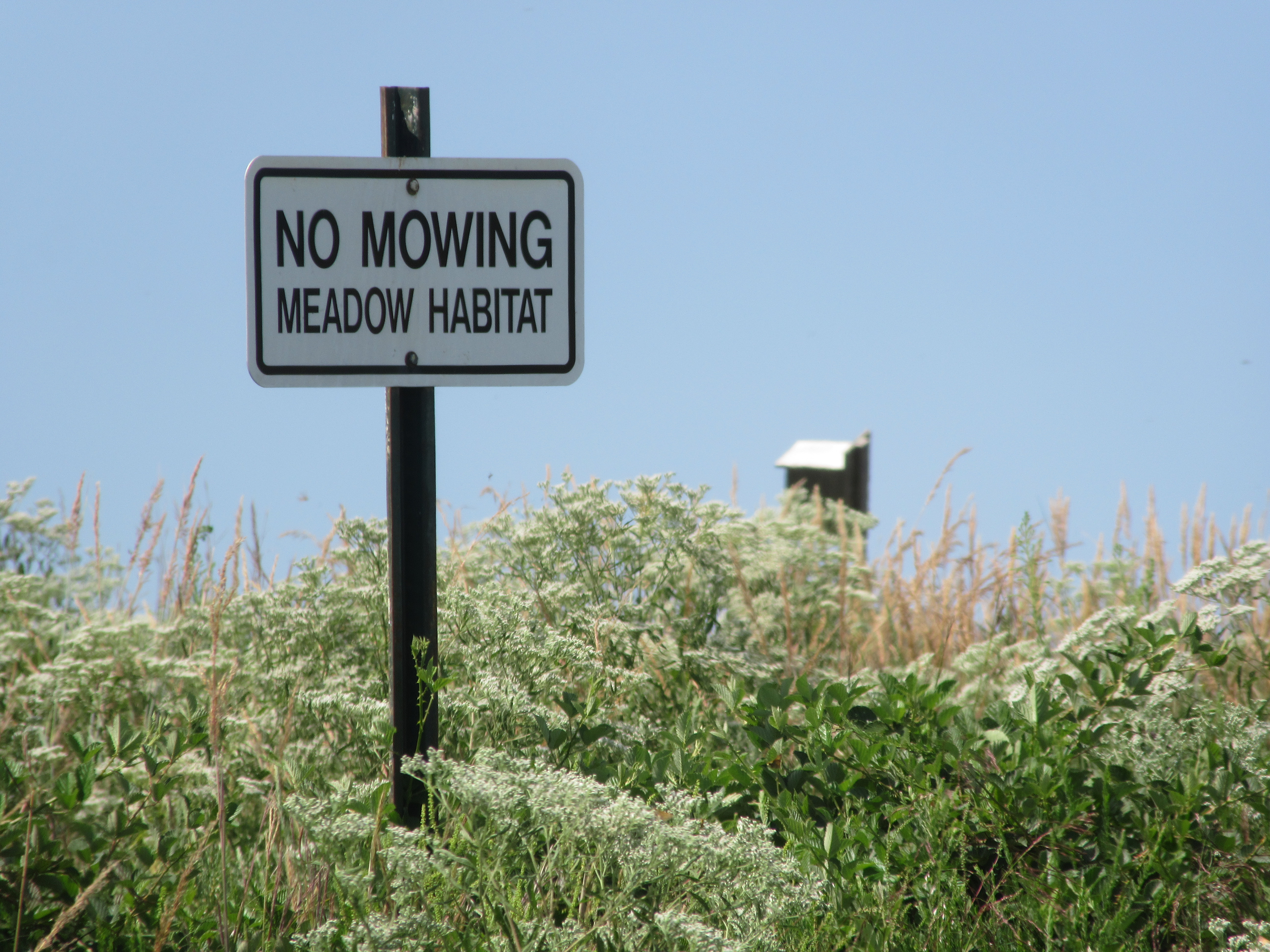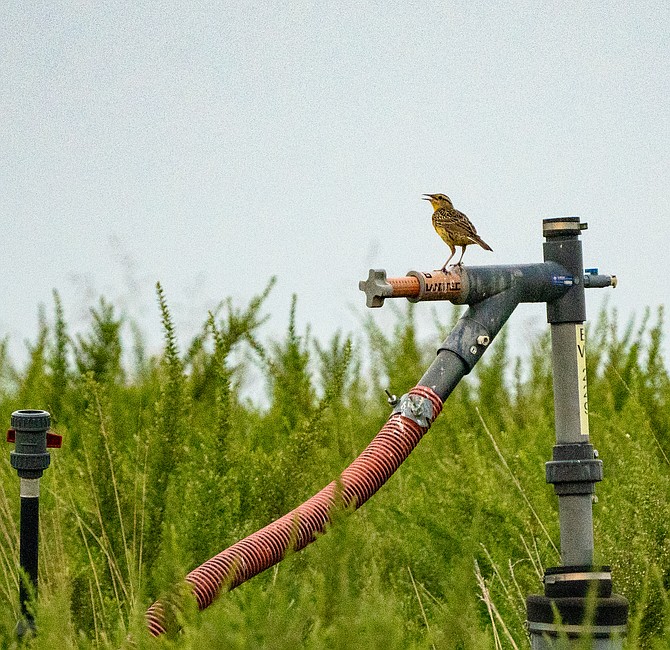
The no-mow zone continues to provide critical habitat during the peak breeding and nesting season, attracting birds like the Eastern Meadowlark above, and grasshopper sparrow.
Few people find visiting a landfill enticing, but some of our avian friends do.
Grassland and other birds are using a closed portion of the I-95 landfill, according to a recently released Fairfax County report.
In 2024, at the urging of the Northern Virginia Bird Alliance and with the Board of Supervisors’ support, landfill managers designated 50 closed acres of the 500-acre landfill as a “no-mow” zone. The managers agreed to avoid mowing during grassland birds’ nesting season and to raise mower blades to an eight-inch height when they did mow.
County officials concluded, based on 2024 and 2025 surveys, “overall observations confirm that the no-mow zone continues to provide critical habitat during the peak breeding and nesting season.” County staffer Kimberly Lewis wrote, “The Eastern meadowlark and grasshopper sparrow, among other species, are thriving on a 50-acre meadowland atop the landfill.”
By modifying and reducing mowing, the area is in effect a grassland, albeit not a natural one. The project sought to determine which grassland birds are using the area and how.
“The Eastern meadowlark and grasshopper sparrow, among other species, are thriving on a 50-acre meadowland atop the landfill.”
— County staffer Kimberly Lewis
In 2025, Blair Evancho, a county intern, staffers and volunteers conducted weekly bird surveys from May 1 to July 12, 2025 and recorded all bird species observed. They confirmed 40 bird species in this area in 2025, including four species of regional or continental concern: chimney swift, grasshopper sparrow, Eastern meadowlark and bobolink. “Notably, the grasshopper sparrow, a grassland nester experiencing regional population declines, was the most detected species,” notes the county’s report. In 2024, surveyors confirmed 29 bird species.
“The County’s monitoring efforts show that the I-95 Landfill Complex continues to provide meaningful habitat for grassland birds, including several species of conservation interest,” commented Duane Wright, Director, Solid Waste Management Program. “These findings reflect our commitment to thoughtful land management that supports both environmental stewardship and long-term site care.”
“On survey days, at least one Northern Virginia Bird Alliance (NVBA) volunteer helped,” NVBA President Libby Lyons said. “We commend the County for this approach and hope this project can serve as a role model for other landfills in taking such important conservation steps,” she said.
According to the 2025 report, one glitch was “unanticipated mowing on three days in June during work on a new solar field next to the no-mow zone, which created “a noticeable decline in bird activity on those dates.” The report indicates that this mowing “conflicted with the established protocol, which prohibits mowing in the no-mow zone during the April – September breeding season, except when required for access to monitoring wells.”
Grassland Birds
Grassland birds rely on grassland habitats for nesting and many species have seen marked drops in numbers. Since 1970, grassland birds have declined by 43 percent, concluded the 2025 State of the Birds report by the North American Bird Conservation Initiative. The main driver is habitat loss.
Most of the eastern United States’ natural grasslands are gone. These birds typically do not use other habitats. In Virginia, since the European colonists’ arrival in the 1600s, only a fraction of the state’s grasslands remain. “It may be less than .0001 percent,” according to biologist Justin Folks quoted on the Virginia Outdoors Foundation’s website.
“The landfill has the largest patch of grassland in eastern Fairfax County,” ornithologist Greg Butcher said in our 2024 Connection article. Landfill managers usually put a cover on closed landfills and plant grasses to stabilize the surface.
Wright concluded, “By maintaining a clearly defined seasonal no-mow period, the County is able to support important nesting and foraging activity while also ensuring the landfill remains well maintained and protective of the environment. This balanced approach allows us to responsibly manage closed landfill areas while recognizing their value as part of the region’s broader ecosystem.”